

D-H Table Explain
Hi everyone!
I'm really confusing with the D-H table. Can you enlighten me how theta offset works and why alpha_3 is 90 degree instead of -90 (since alpha_3 is angle about common normal x3 from z2 to z3)?
Thank you so much!
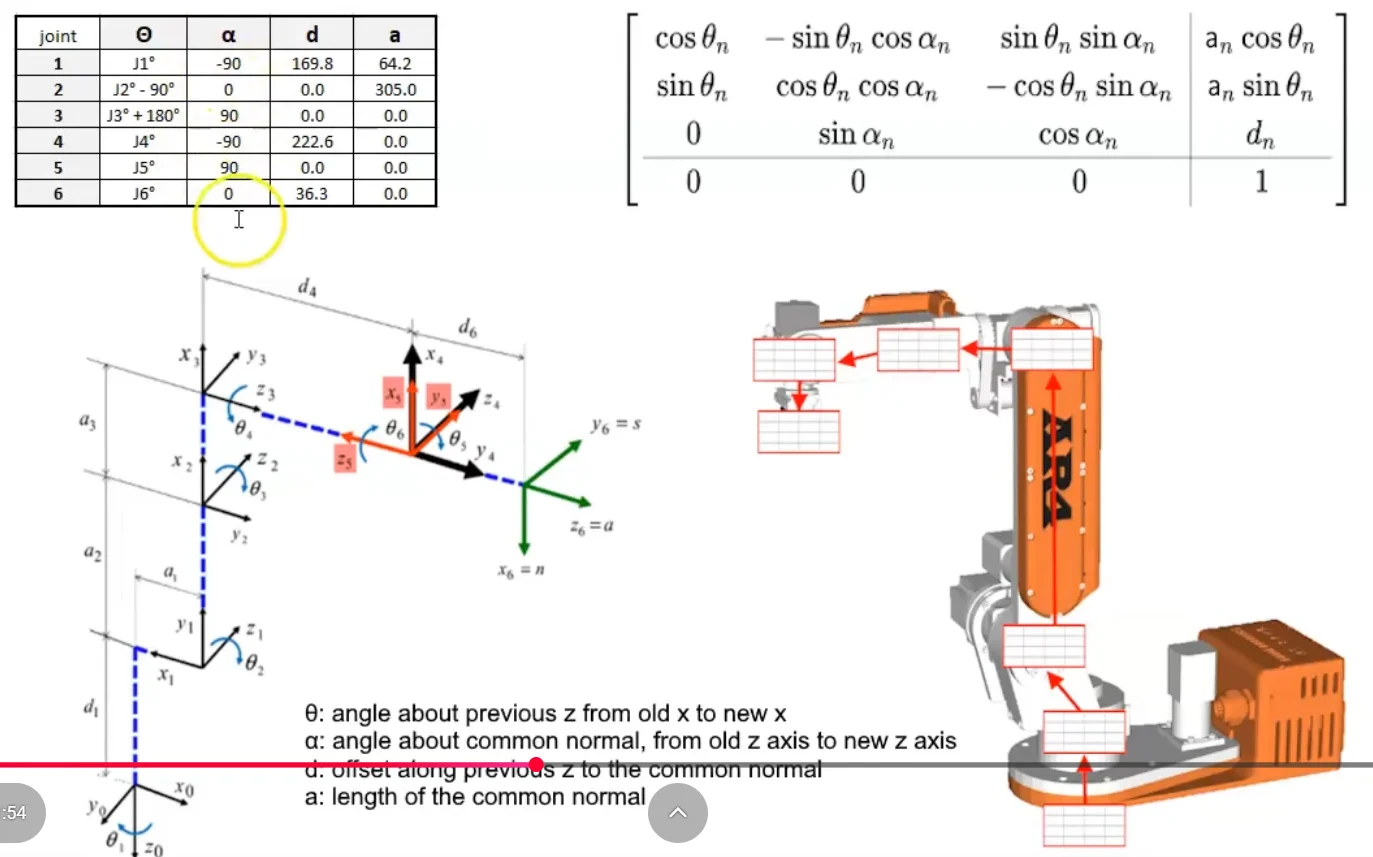

In the AR4 D-H table, the θ offset simply corrects for the difference between the robot’s mechanical zero (where each joint is physically aligned to its home mark) and the mathematical zero required by the D-H convention.
Mathematically:
[
\thetai = \theta{measured} + \text{offset}_i
]
That offset ensures the robot’s forward kinematics produce the correct pose when all joints are at their home position.
For example, if your J2 link points horizontally when the D-H convention expects it to start vertically, the offset rotates it into alignment.
Why α₃ = +90° instead of 90°
The α (alpha) parameter defines the twist angle between two consecutive joint axes - the rotation about the x₃ axis from z₂ to z₃.
Using the right-hand rule, a positive rotation about x₃ moves z₂ toward z₃.
In the AR4’s geometry:
- z₂ points along the J2 joint axis (vertical in the home position).
- z₃ points forward along the J3 joint axis (horizontal).
To rotate z₂ (+Z up) into z₃ (+Z forward) following the right-hand rule about the x₃ axis, you rotate +90°, not −90°.
If you reversed one of the coordinate frame directions (for example, flipped an x or z axis), then α₃ would indeed be −90° — but that would also break consistency with the right-hand rule used throughout the AR4’s DH frame assignments.
In short
- The θ offset aligns mechanical zero with the D-H reference zero.
- α₃ = +90° because, per the right-hand rule, rotating +90° about x₃ correctly brings z₂ into z₃ for the AR4’s joint orientation.
Both values are consistent with the AR4’s 3D model, joint motion direction, and the Modified D-H convention used in the official kinematics code.

Chris Annin I’m very grateful for your reply. However, I still don’t understand the part about α₃. According to the right-hand rule, rotating by 270 degrees should bring z₂ to z₃, right? And it seems like you used the left-hand rule for frame 3, didn’t you?