
CTE guide
A Robot Arm for High School CTE
Career and technical education works best when students handle the real thing. With the AR4, students build a six axis arm, wire it, bring it to life and program it, using the same ideas as industrial robots.
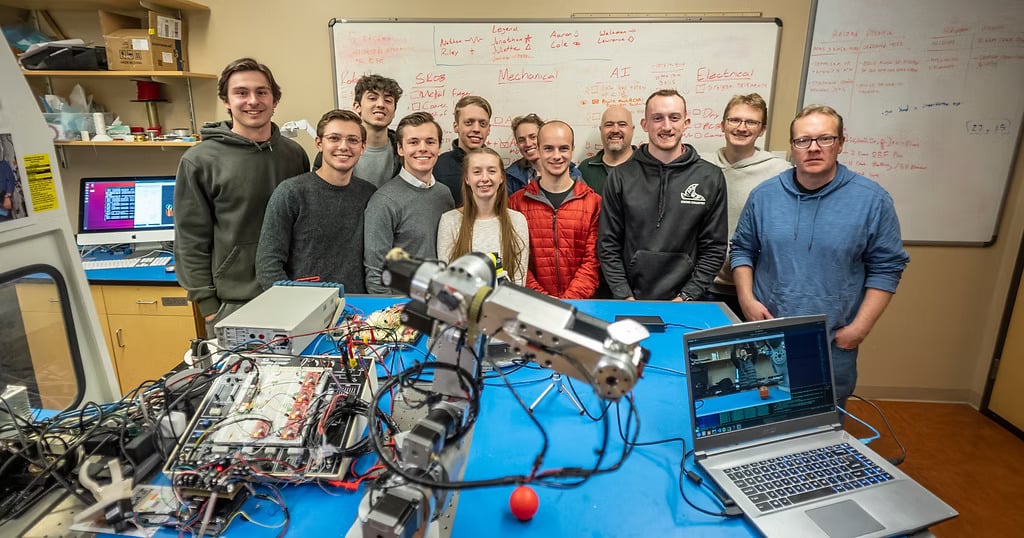
Build, wire, program
The AR4 classroom guide groups the skills into CAD and 3D printing, electronics, programming (Python, ROS, G-code, Arduino C++, Modbus for PLCs), kinematics and troubleshooting, and safety for human and robot work.
Axes
6
Program
8 to 12 weeks
Kit + motors
$1,928
Licenses
None needed
Why a build kit suits CTE
Many classroom arms arrive sealed. The AR4 is the opposite: students can see every bearing, belt, driver and wire. That makes it a natural fit for CTE pathways that care about how equipment is assembled, maintained and diagnosed, not only how it is programmed.
Manufacturing
Read the bill of materials, assemble joints, set belt tension, and print covers and spacers on a school 3D printer.
Electrical
Wire motors, drivers and sensors, check continuity with a multimeter and find wiring faults.
Automation
Teach points, write pick and place routines, then connect inputs, outputs and a PLC.
A sample semester plan
This outline follows the modules in the sample curriculum. Pick the modules that match your pathway; the advanced theory modules are optional for high school.
- Step 1Mechanical assemblyTechnical drawings and BOMs, bearings and fits, fasteners and gear reduction, while teams assemble the structure.
- Step 2Electrical systemsSchematics, stepper motors and drivers, power distribution, signal vs power wiring.
- Step 3Embedded controlMicrocontroller basics, digital I/O and serial communication, uploading the Teensy firmware.
- Step 43D printingPrint the covers and spacers, tune slicer settings and evaluate part strength.
- Step 5Robot programmingJoint vs Cartesian coordinates, motion types, teach points and a pick and place routine in the AR4 HMI.
- Step 6CapstoneAdd a gripper and I/O and build a complete automated task such as sorting.
The curriculum suggests rotating teams (mechanical, 3D printing and programming) so every student touches each part of the system over the unit.
Safety in a high school lab
- Bolt or clamp the 27 lb arm to a sturdy bench and mark its 24.75 in reach envelope.
- Keep hands out of the envelope while a program runs, and keep a power cutoff within reach of the operator.
- Have students test programs in the HMI's virtual robot first, then run slowly on the real arm.
- Teach risk assessment for human and robot interaction as part of the unit.
Teacher tools and resources
The free online build course follows the manual lesson by lesson; students mark lessons done and earn a certificate. With the instructor tools you create a class, assign a course, share a join code, see who is stuck or inactive, set due dates and download the class list.
Equip your lab
Get a school quote
Choose kits and spare parts and we email a pro forma invoice for your purchasing office.
Keep reading
FAQ
Is the AR4 appropriate for a high school CTE program?
The AR4 curriculum lists high school STEM and CTE among its suitable programs. Because it is an industrial style arm and not a cobot, run it with the same supervision and safety rules you use for other powered lab equipment.
What do high school students learn with the AR4?
Mechanical assembly, wiring and electronics, 3D printing, robot operation and programming in the AR4 HMI, Python, and for advanced students kinematics, simulation and PLC communication.
How long is a typical AR4 unit?
The sample curriculum is laid out as an 8 to 12 week program mixing lecture, hands-on lab and simulation. You can use the modules you need.
Can students practice without the arm?
Yes. The AR4 HMI has a virtual robot for offline programming, so students can write and test programs on a PC before running them on the arm.
How do teachers track progress?
Create a class, assign the online build course and share the join code. You see each student's progress, who is stuck or inactive, set due dates and download the class list.
How do we order for a school?
Request a quote to receive a pro forma invoice PDF for your purchasing office, then pay by purchase order or online.