
Kit guide
6 DOF Robot Arm Kit: Six Real Joints
Six degrees of freedom is what lets an arm put its tool anywhere in its workspace at any angle. Here is what that means, how to read DOF claims, and how the AR4's six joints are laid out.
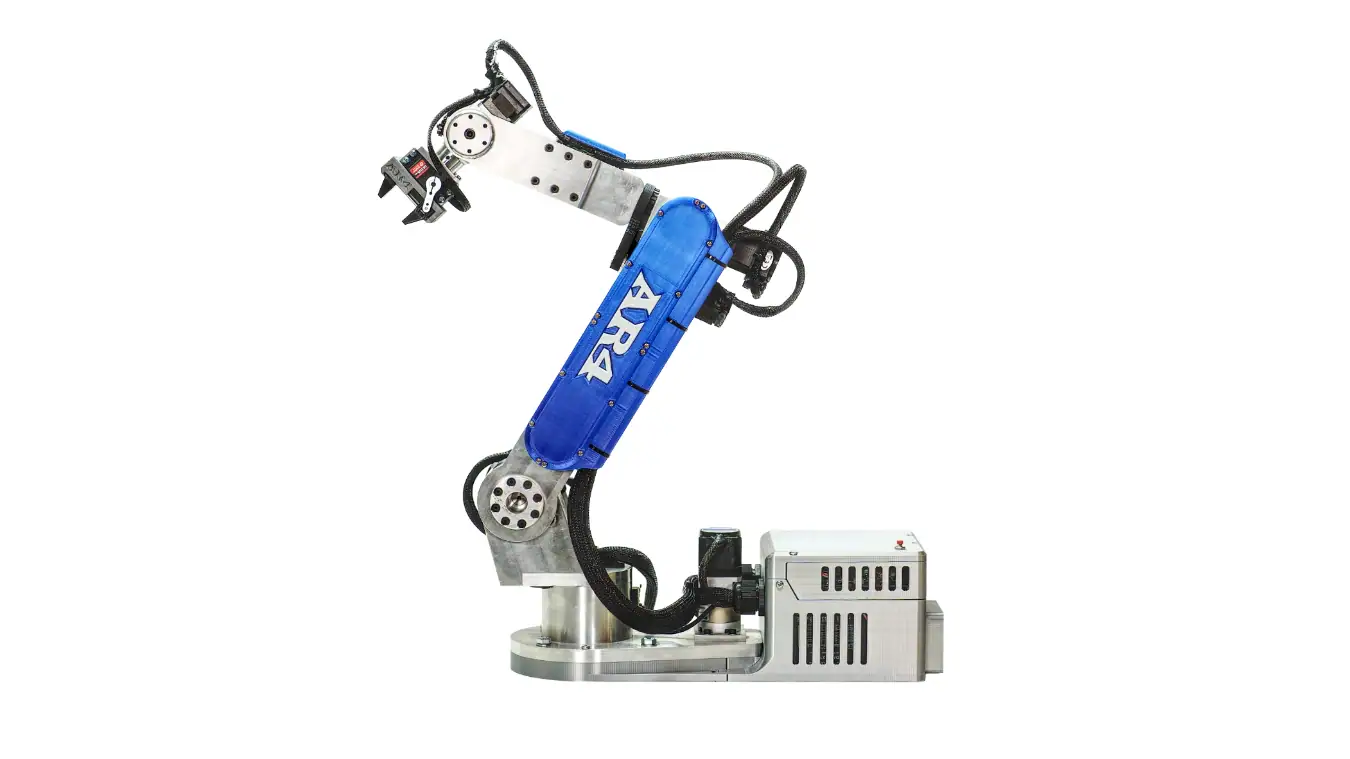
Six arm joints, plus a gripper
The AR4 has six arm joints driven by closed loop stepper motors, with a gripper on its own controller. Up to three more axes can be added for a track or turntable.
Arm joints
6
Extra axes
Up to 3
Payload
1.9 kg
Kit + motors
$1,928
What 6 DOF actually means
A rigid object in space has six degrees of freedom: three for position (X, Y, Z) and three for orientation (roll, pitch, yaw). An arm needs at least six independent joints to control all six, so it can approach the same point from different angles, keep a tool level while it moves or tilt a part to fit it into a fixture.
With five joints, one orientation is always tied to the others. That is fine for many pick and place jobs, but it limits what the arm can do at the wrist.
Reading DOF claims
Product listings do not all count the same way. Hiwonder, for example, lists the xArm 1S as "6DOF (5DOF + Gripper)", and Seeed Studio lists the SO-101 as five joints plus a gripper. Both are useful arms, but their sixth "degree" is the gripper. See AR4 vs xArm 1S and AR4 vs SO-101.
- Count the arm joints, not the gripper.
- Check that the wrist has three joints if you need full tool orientation.
- Look for published joint ranges, not only a DOF number.
The AR4's six joints
| J1 Base | ±170°, Hall effect homing |
|---|---|
| J2 Shoulder | ±90°, Hall effect homing |
| J3 Elbow | −10° to +150°, Hall effect homing, HTD belt drive |
| J4 Wrist roll | ±180°, microswitch homing |
| J5 Wrist pitch | ±120°, microswitch homing |
| J6 Tool roll | ±180°, microswitch homing |
J1 to J3 place the wrist. J4 to J6 form a spherical style wrist that orients the tool. Every joint has encoder feedback, and a 600 MHz Teensy 4.1 solves the kinematics so linear and arc moves stay on path.
Configurations and singularities
A six joint arm can often reach the same pose more than one way, for example with the wrist flipped or not flipped. Near a wrist singularity, small tool moves need very large joint moves. The AR4 HMI lets you pick the wrist configuration, and the inverse kinematics guide explains the math.
Beyond six axes
The AR4 controller can drive up to three additional axes. Chapter 6 of the build manual shows a 7th axis travel track; the manual also lists a turntable, camera focus and a stepper driven gripper as uses. See the 7th axis guide.
Kit plus motors
$1,928
Combo kit $1,229 + StepperOnline motor package $699. Grippers and printed covers are extra.
Keep reading
FAQ
What does 6 DOF mean on a robot arm?
Six degrees of freedom: six independent joints. Three mainly place the wrist in space and three orient the tool, so the arm can reach a point from different angles.
Is a 5 DOF arm with a gripper a 6 DOF arm?
Some makers count the gripper as a degree of freedom, so a listing that says 6 DOF can mean five arm joints plus a gripper. The AR4 has six arm joints, and its gripper is driven separately.
What are the AR4 joint ranges?
J1 ±170°, J2 ±90°, J3 −10° to +150°, J4 ±180°, J5 ±120° and J6 ±180°.
Can the AR4 have more than 6 axes?
Yes. The controller can drive up to three additional axes (7th, 8th and 9th), such as a travel track, a turntable or a stepper driven gripper.
Why does a 6 DOF arm have singularities?
At certain poses, such as when two wrist axes line up, the arm loses one way to move and the joint speeds needed for a straight line grow very large. The AR4 advanced move types tutorial covers wrist singularity and flip and no flip configurations.